Heart Rate Drift in LIT: What It Mean & When to Worry
Heart Rate Drift: The Silent creeping metric
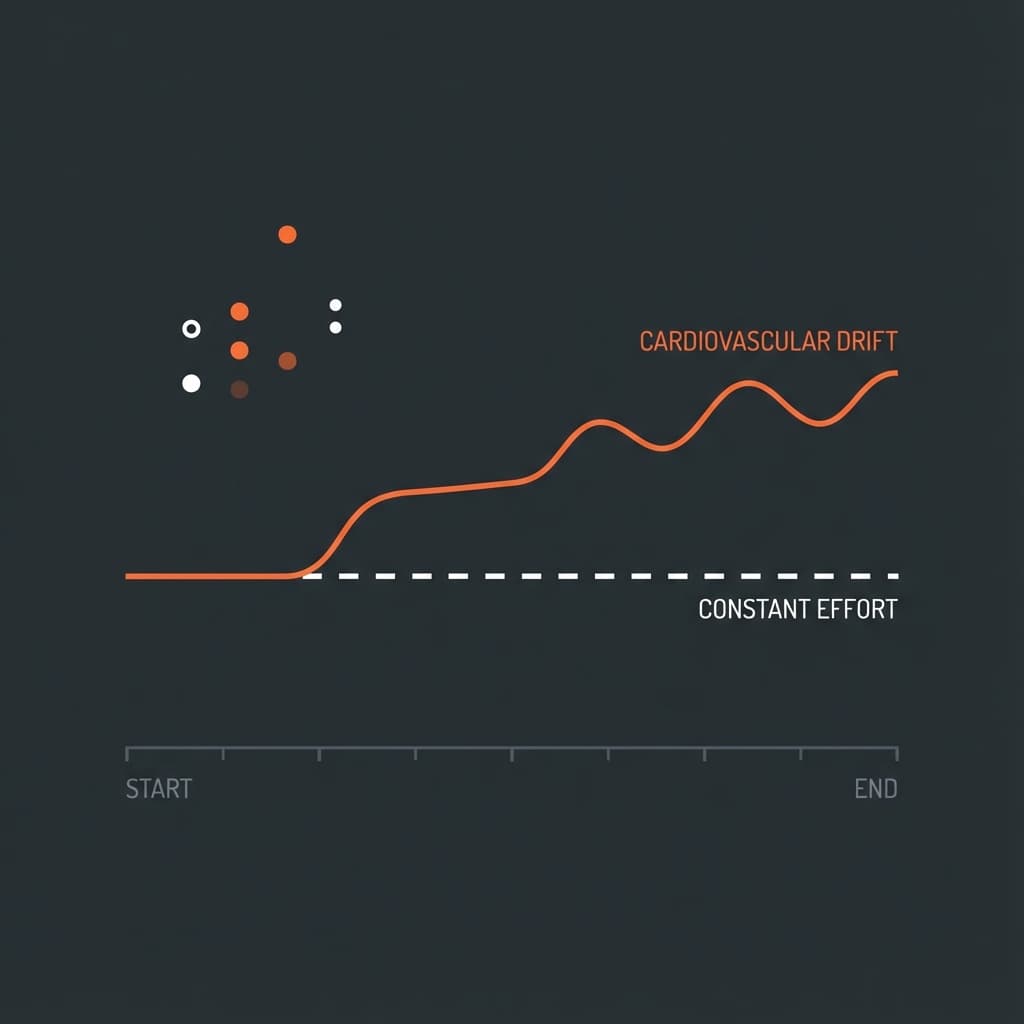
You are one hour into your Zone 2 ride. Your power is steady at 200 watts. You feel good. But when you look at your computer, your heart rate has crept up from 130 bpm to 142 bpm.
This phenomenon is called Cardiac Drift (or Cardiovascular Drift), and it tells a fascinating story about your body's physiology.
What is Cardiac Drift?
Cardiac drift occurs when your heart rate slowly increases during steady-state exercise, while your workload (power or pace) remains constant.
It typically begins after 10-15 minutes of continuous exercise.
$$ Cardiac Output = Stroke Volume \times Heart Rate $$
Your body wants to maintain a stable Cardiac Output (blood flow) to fuel your muscles. As your core temperature rises and you sweat (decreasing blood plasma volume), your specific Stroke Volume (amount of blood pumped per beat) decreases. To compensate and keep Cardiac Output steady, your heart rate must increase.
Is It Bad?
Not necessarily. Some drift is physiological and expected, especially in:
- Hot conditions.
- Long durations (>90 mins).
- Dehydrated states.
However, excessive drift in a standard LIT (Low Intensity Training) session can signal a lack of aerobic endurance.
The Decoupling Metric (Pw:HR)
TrainingPeaks and other platforms call this "Decoupling". It compares the first half of your ride to the second half.
- < 3% Drift: Excellent aerobic fitness. Your body is handling the stress efficiently.
- 3% - 5% Drift: Normal/Acceptable range.
- > 5% Drift: Aerobic system is struggling. You might be dehydrated or the ride duration is currently beyond your fitness level.
Practical Application
If you see consistent drift > 5% on your easy rides:
- Check Hydration: Are you drinking enough electrolytes?
- Check Cooling: If indoors, get a better fan. Heat accumulation kills performance.
- Reduce Duration: You might be doing 3-hour rides when your fitness only supports 2 hours efficiently.
- Cap the HR: In a Zone 2 ride, if your HR drifts into Zone 3, back off the power. Stay in the zone physiologically, even if it means riding slower.
Understanding drift turns a simple "easy ride" into a powerful diagnostic tool for your endurance.